Monday, August 17, 2015

Bringing the Brain Together

The model of left brain/right brain that evolved in the 1960's now makes for a terrific metaphor: The idea was that the left hemisphere holds the logic of the critical thinker, the right hemisphere holds the imagination of the creative thinker, and for each of us, one side is more dominant than the other.

We now know that certain cognitive functions and other specific brain activities may be located in a particular part of the brain but it is their interaction that maximizes thinking. In other words, thinking requires skills in critical analysis as well as creativity. When the synapses fire between the areas of the brain, thought happen.

Writing requires both critical and creative thinking skills. Your challenge is determining how to use your skills effectively. Do you think about the beginning and end before filling in the middle? Do you know the middle before deciding upon your thesis and conclusion? Do you spew words before refining? Do you outline before proceeding?

Draw upon different sides of your brain, especially when stuck. You may surprise yourself. 

Thursday, July 30, 2015

Creative and Critical Thinking


  • If you can't think, you can't write.
  • If you don't think before you write, you could end up spewing verbiage that remains an unfinished draft that doesn't captivate readers or audience.
  • If you don't develop critical thinking skills, your expressions could wander around aimlessly and lack depth.
  • Without creative thinking skills, your writing unique writing voice will not be expressed.
Developing your creative and critical thinking skills will enhance your writing before you put words on the page. Consider outlining, mapping or even making notes before you begin, even if you find a need to veer in a different direction.

The map is not the territory.

Saturday, July 11, 2015

Incorporating New Ideas

Thinking and writing are work -- fun, but still work. Sometimes you have to switch gears because you discover a new idea or concept that reshapes your original intention. Other times the feedback from others forces you to rethink your intention or how you can best fulfill your intention.

Change is hard and changing your mind is even harder. When you are writing or thinking about what you're writing, you may need to take time to let your thinking change to incorporate new ideas, include new information or assimilate feedback. You may even surprise yourself when you succeed.

Let your work evolve. This may mean discarding large chunks of what you have written. No, you didn't waste time writing what you discarded and yes, you just might use it elsewhere.

BE NOT AFRAID or be afraid and do it anyway.

Wednesday, May 13, 2015

Truthseeking

Whether you are writing fiction or nonfiction, you need to write what is true. You want your reader or audience to feel the truth in whatever you are writing. Even the most exotic fantasy or science fiction is rooted in a truth that resonates.

Truth isn't only about facts and evidence. Truth requires a willingness to be vulnerable to the feelings it provokes. As a writer, when you show the value of seeking truth, you take your reader or audience with you so that they also want to seek truth.

Beware of "truthiness" -- truth laced with fallacies. Honesty is challenging but worth the effort.

Thursday, May 7, 2015

The Map is not the Territory

A guy talked about the book he was developing. He was excited because he'd worked through a complex plot with dynamic characters for his science fiction novel. There was no doubt in his mind that the final product would be well-received.

There was just one thing. Although he did all of the thinking preparation, he had yet to write anything down. He claimed that all he had to do was type up what he was thinking. End of story.

The act of writing is an act of discovery. Thinking and planning are vital for successful writing, but so is writing and rewriting. Putting words to paper (or screen) is a process unto itself. You make a commitment to the process in a way that will shape and reshape your original thoughts.

Just as acting is reacting, writing is rewriting.

Wednesday, April 29, 2015

Creative Thinking and Inductive Reasoning


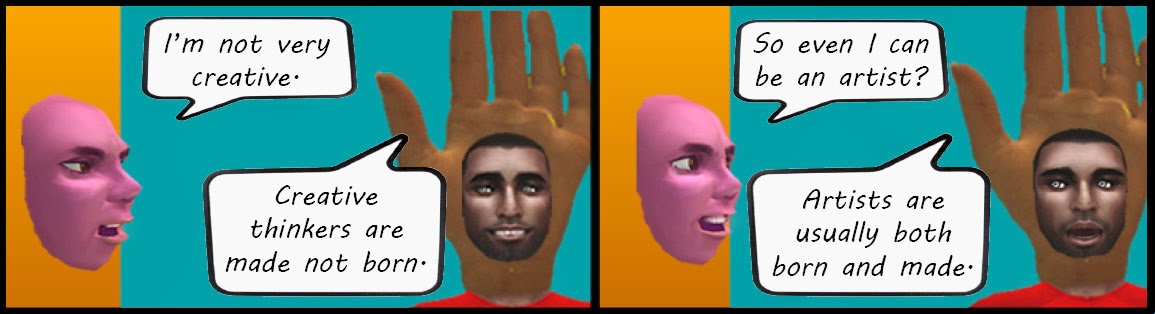
You may or may not think of yourself as particularly creative. Just because you can't draw, make music or perform double pirouettes doesn't mean you can't be a creative thinker. Yes, much of your creative impulses were educated out of you, but there is hope. All you have to do think creatively is move out of your comfort zone and explore new ideas.

Inductive reasoning is your friend. Although the conclusions of inductive reasoning are uncertain, First you collect data and evidence and then you draw a conclusions. Your reasoning may prove effective or may result in a fallacy. Whatever. The exercise of inductive reasoning will help you think more creatively.

Monday, March 30, 2015

Gender Challenge

You don't always need to include gender as a target market, but sometimes it helps. For example, the sexiness of Fifty Shades of Grey attracts both genders, but the overall content targets women. This was no easy feat and E.L. James rose to the occasion. That's not to say that this book (and now movie) is brilliantly written, but it did gain traction beyond those who regularly read chick lit.

Part of identifying your target market will not only help you recognize for whom you are writing, but will help you cultivate your unique writing voice.Also, cultivating your writing voice will help you better identify your target market.

When critiquing, recognizing some of the fundamental differences between you and the author or writer will help you better understand their work. You may not be the target market, but applying creative and critical thinking skills will assure a better result.